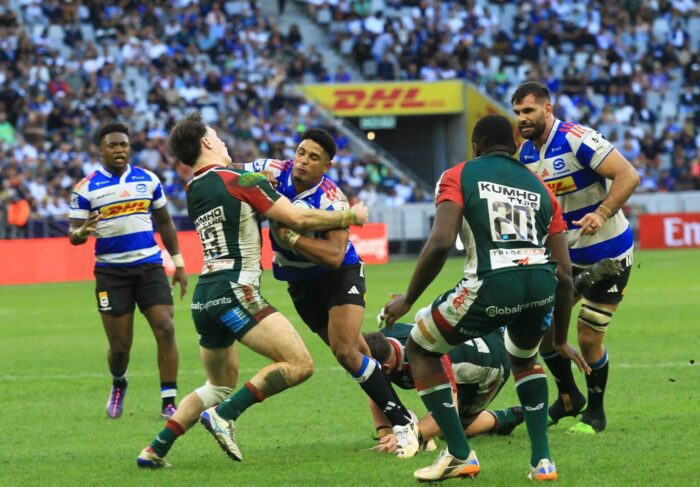

The Stormers may have marched into the Investec Champions Cup last-16, but their performance was not a polished symphony, but more a garage band that occasionally forgot the chords.
Yes, the scoreboard reads 39–26. Yes, Leicester Tigers were beaten. But context is king, and this particular Tiger arrived in Cape Town with more stripes missing than a clearance-rack jersey.
A significantly weakened Leicester side, stripped of several frontline names, still managed to snarl often enough to expose some uncomfortable truths in the Stormers’ performance.
Sacha Feinberg-Mngomezulu, captaining the side for the first time, admitted it was no stroll.
“It was a really tough game and there were patches where I had to lean on other leaders,” he said.
That reliance was visible. At times, the Stormers looked like a side trying to play at warp speed while skipping the pre-flight checklist. Passes hit the turf, exits went missing, and defensive alignment occasionally resembled a WhatsApp group arriving at different times to the same braai.
Coach John Dobson was honest about the tension of the contest.
“It was a stressful game, a proper contest,” he said. “I know they left a few guys at home… It was still a really good Leicester team.”
True, but a “really good” Leicester still found space far too easily. The Stormers were flat early, something Dobson himself acknowledged.
“They were organised and put us under pressure, especially in the first half when we were a bit flat and not putting pressure on the set-piece or their lineout.”
Flatness is survivable in pool rugby. In knockout territory, it’s a luxury you don’t own.
Feinberg-Mngomezulu summed up the Stormers’ biggest contradiction, their greatest strength and their most dangerous habit.
“Our DNA has brought us success and trophies, so we lean on it,” he said.
“But the next step is knowing when to kick and manage territory… Sometimes we drift, and it comes from a good place, but it costs us.”
That drift was evident. The Stormers’ attack still flashed because it always does, but it came wrapped in loose decision-making.
Champagne rugby, again, served in a paper cup. When the plan was followed, points flowed. When instinct took over unchecked, chaos followed close behind.
Defensively, the warning lights glowed brightest. Even with disrupted combinations, Feinberg-Mngomezulu insisted the system should hold.
“We train in mixed combinations all the time, so the next guy is always prepared,” he said.
“That’s what we pride ourselves on – covering each other’s backs.”
Preparation, however, didn’t always translate into protection. Soft metres were conceded, first-up tackles slipped, and Leicester – underpowered or not – were allowed to look far more dangerous than the team sheet suggested.
Dobson remains clear-eyed about the scale of the challenge ahead.
“This is proper European rugby,” he said. “Win this competition, you’re the best team in Europe.”
And that’s the crux of it. Proper European rugby doesn’t forgive sloppiness. It doesn’t care about DNA, narratives or good intentions. It punishes missed tackles, lazy exits and defensive daydreams with ruthless efficiency.
The Stormers are through. That’s the headline.
The sub-headline is less comfortable: if they want to go all the way, the basics must stop being optional extras.
Winning ugly still counts. Winning sloppy comes with a warning label. Europe’s elite won’t arrive half-strength, and they won’t be nearly as forgiving.
Photo Credit: Rashied Isaacs